

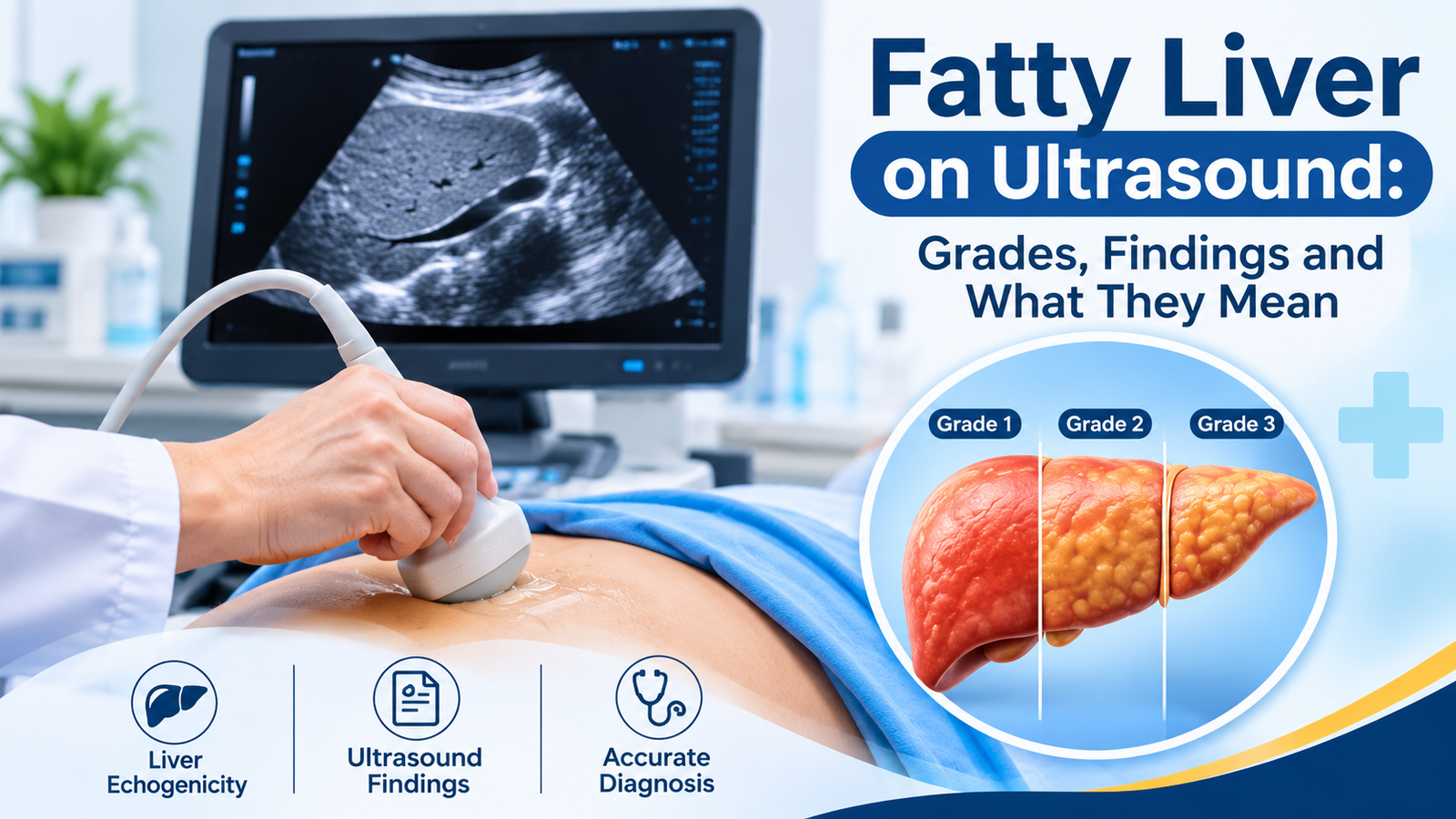
Fatty liver is a relatively common condition in which excessive amounts of fat build up in the cells of the liver. Identifying fatty liver at an early stage will allow for the condition to be evaluated and for recommendations about lifestyle changes and further examinations to be made. The Fatty Liver Ultrasound is a frequently performed imaging study.
At Central Diagnostics, you will be able to undergo diagnostic imaging services that can help you with the diagnosis of liver issues. Knowing the results of the scan, as well as the grading of its severity, can help you make better-informed decisions about your health. Regardless of whether you are looking into an incidental finding or simply following your doctor’s advice, knowing what the diagnostic process entails can make things much easier for you.
What Is Fatty Liver and How Is It Identified Through Ultrasound?
Fatty liver is a condition where there is an accumulation of fats in the cells of the liver. This condition is common in obese individuals, diabetics, those with insulin resistance, those with high cholesterol, and some lifestyle conditions. However, this condition can also be found in asymptomatic individuals.
A detailed fatty liver ultrasound will help in the evaluation of the echogenicity of the liver, which is the brightness that the liver tissues produce in the ultrasound image. A brighter liver than the kidneys is an indication of fat deposits.
An ultrasonic test performed at the experienced ultrasound lab in Uttam Nagar could assist in evaluating liver structure and finding the need for further medical analysis. An ultrasound test is a non-invasive test that makes no use of any radiation source.
Schedule an imaging consultation to know more about your liver condition and determine what is the best course of action.
Fatty Liver on Ultrasound: Grades 1-3 Explained
The grades of fatty liver are usually used to describe the level of fat deposition through ultrasound imaging. A graded fatty liver ultrasound assessment can help doctors understand the severity of visible changes.
| Grade | Ultrasound findings | General interpretation |
| Grade 1 | Mildly increased liver brightness | Mild fat accumulation |
| Grade 2 | Moderately increased echogenicity | Moderate fat accumulation |
| Grade 3 | Markedly increased echogenicity | Severe fat accumulation |
1. Fatty Liver Grade 1
Grade 1 fatty liver refers to mild fat accumulation in the liver, making it appear slightly brighter on ultrasound. The deeper abdominal structures and diaphragm remain visible. At Central Diagnostics, we provide reliable ultrasound services for accurate assessment of liver health.
2. Fatty Liver Grade 2
Fatty Liver Grade 2 disease occurs when there is moderate accumulation of fat and increased liver echogenicity becomes more evident. There could be difficulty in visualizing deeper liver structures and vessels.
3. Fatty Liver Grade 3
Fatty Liver Grade 3 implies that there is significant fatty infiltration in the liver. There will be increased brightness of the liver, and the diaphragm and vessels inside the liver will not be visible.
The most important thing here is to state the fact that the grading of ultrasounds is an assessment of the quality of the picture and not the fat or liver damage.
Also Read: When Is Fetal Echocardiography Recommended During Pregnancy, and What Does It Check?
What Are the Common Fatty Liver Ultrasound Findings?
During an advanced fatty liver ultrasound examination, the radiologist evaluates several features that may indicate hepatic steatosis.
Common findings include:
- Increased liver echogenicity: The liver appears brighter than expected.
- Hepatorenal contrast: The liver looks brighter compared with the right kidney.
- Vascular blurring: Liver blood vessel walls may become less distinct.
- Reduced deep penetration: Severe fat accumulation can limit the visibility of deeper structures.
- Poor diaphragm visibility: The diaphragm may appear less clearly defined.
These findings help identify fatty liver but should be assessed along with the patient’s medical history and other test results. At Central Diagnostics, we emphasize accurate diagnosis and proper evaluation.
Why Is Ultrasound for Fatty Liver Important?
Some of the benefits of a successful fatty liver ultrasound include:
- Helps identify suspected fat accumulation in the liver.
- Provides information about liver appearance and structural changes.
- Useful for evaluating incidental findings in the liver.
- Helps doctors decide whether additional investigations are required.
- Enables noninvasive testing without radiation.
Nevertheless, traditional ultrasound fails to provide any information concerning liver inflammation or fibrosis stages. The doctor might suggest performing either blood tests or elastography. In order to conduct an accurate diagnosis, patients can visit the best diagnostic lab in Dwarka as recommended by the treating doctor.
Get the appropriate diagnostic investigations done with professional assistance and timely appointment support.
How to Prepare for a Fatty Liver Ultrasound?
Proper preparation may help improve the quality of abdominal imaging. Please follow the guidelines given by your diagnostic center.
Generally, preparation may include:
- Fasting for 6 to 8 hours if required.
- Drinking water as per advice from the centre.
- Sharing information about any pre-existing medical conditions and medication being taken.
- Bringing previous ultrasound reports and test results.
The requirements for preparation might differ from one test to another and according to personal situations.
Why Choose Professional Diagnostic Imaging?
An experienced diagnostic center can be of immense help in getting images as well as reliable reports of the same. Central Diagnostics strives to provide quality services to patients by making use of adequate diagnostic machines along with the right radiologists. From coordinating your appointment right through to guiding the patient, everything is geared to ensuring a better diagnostic process. The objective of Central Diagnostics is to offer imaging services to the patients who seek diagnostic assistance from our organization.
Conclusion
Fatty liver can develop without noticeable symptoms, making appropriate evaluation important when recommended by a doctor. A dependable fatty liver ultrasound is useful for detecting any changes in the liver’s appearance and gives an idea about mild, moderate, or severe fat deposition.
Nevertheless, imaging alone is not enough to assess the overall health condition of the liver. In certain instances, there is a need to consult and carry out other assessments. At Central Diagnostics, our imaging technology will assist you in gaining more insight about the health issues that may be affecting you. Let us help you move forward by conducting a proper exam. Contact the team to inquire about available scan timings and examination details.