

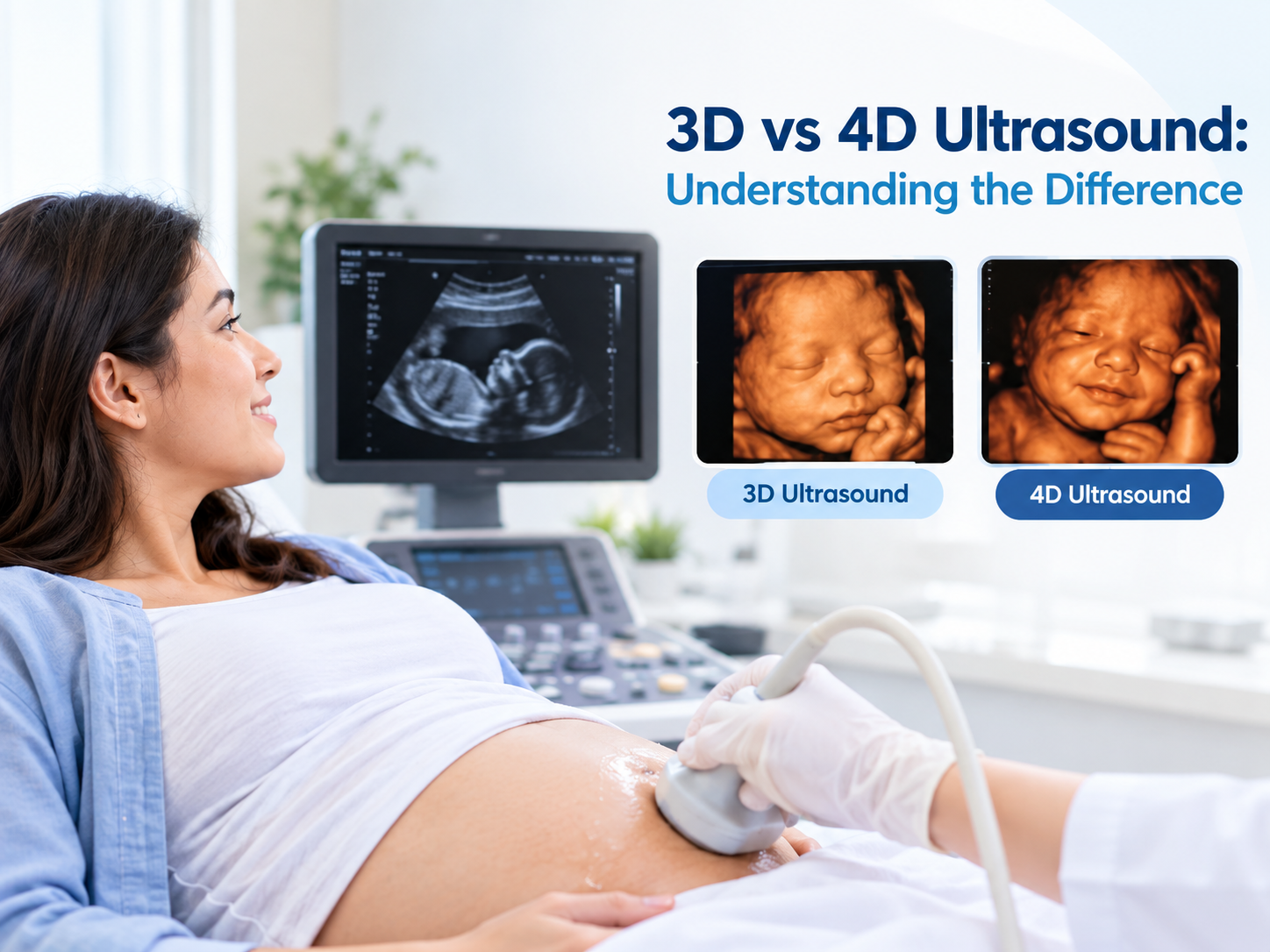
It may not always be easy to figure out which ultrasound scan to go for during pregnancy when one comes across the names 3D, 4D, and advanced imaging. Knowing the difference will ensure that expectant parents are able to make an informed decision regarding their prenatal imaging requirements. The advanced ultrasound scanning at Central Diagnostics is meant to provide high-quality pregnancy imaging in a comfortable clinical environment.
If you need an anomaly scan centre in Dwarka, or just want to have your routine pregnancy ultrasound scan done, or are seeking prenatal imaging, knowledge of the differences between these types of scans will ensure that you are able to discuss which is best suited for you. This guide provides information on advanced 3D vs 4D ultrasound, the process of each of these scans, their differences, and their use.
What Is 3D Ultrasound?
3D ultrasound produces an image that is three-dimensional in nature by taking several ultrasounds and compiling them into one detailed picture.
For expecting parents, understanding 3D vs 4D ultrasound can make it easier to know what each technology actually does.
Some potential advantages of 3D ultrasound include:
- Three-dimensional images of selected structures
- Detailed visualization of certain external features
- Additional imaging information when clinically indicated
- Easier understanding of certain anatomical views
- Support alongside conventional pregnancy ultrasound examinations
The purpose of the examination should always guide the choice of imaging technology rather than simply choosing the option with the most advanced-sounding name.
Contact to discuss your ultrasound requirements and schedule the appropriate diagnostic examination.
What Is 4D Ultrasound?
The most important distinction between 3D and 4D scanning lies in the aspect of motion. 4D ultrasound makes use of 3D scanning to produce a moving image in real time. Simply stated, creates a 3D image, while 4D integrates motion into this image.
In comparison between advanced 3D vs 4D ultrasound, this motion element is perhaps one of the clearest differences. Depending on the examination and fetal position, 4D imaging may allow movements or facial activity to be observed in real time.
Yet it is not always necessary to opt for 4D imaging when pregnant. Which one should be used will depend on many factors, including the purpose of the scan, gestational age, position of the baby, quality of the image, and recommendation of the health care practitioner.
Interested to know which imaging technique is right for you? Contact for guidance on appointments and our ultrasound services.
Also Read: Is Ultrasound Done on an Empty Stomach? Complete Preparation Guide
3D vs 4D: Key Differences at a Glance
Understanding 3D vs 4D becomes easier when the two technologies are compared directly.
| Feature | 3D Ultrasound | 4D Ultrasound |
| Image type | Three-dimensional still image | Three-dimensional moving image |
| Movement | Not shown in real time | Shown in real time |
| Main feature | Detailed 3D representation | Live 3D visualization |
| Imaging experience | Static view | Dynamic view |
| Clinical use | Depends on examination requirements | Depends on examination requirements |
It should be noted that the difference between 3D ultrasound and 4D does not necessarily imply the advantage of one technology over the other. This all depends on what needs to be checked by the medical specialist.
Thus, one pregnancy can need ordinary scanning, while another case will require more detailed visualization. Clarifying this information prior to booking ensures that you choose the test for the right purposes.
Need advanced ultrasound scanning in Dwarka? Contact us at Central Diagnostics to ask for details and schedule an appointment!
3D 4D Sonography During Pregnancy
It is common practice to refer to “3D” and “4D sonography” when speaking about modern imaging in pregnancies. Both imaging techniques employ ultrasound waves but vary with regard to data presentation.
The procedure of a prenatal ultrasound can be carried out at various stages of pregnancy for various reasons. Depending on the case, 3D or 4D imaging can add additional visualization to the process of ultrasound.
It is essential to note that the given technologies do not always substitute all others in the field of pregnancy scans. A pregnancy ultrasound scan might be required for general examination, while others are intended to investigate some particular fetal structures.
There are several aspects affecting the quality and value of the examination process.
When Is 3D or 4D Ultrasound Recommended?
No one ultrasound test fits all pregnancies. Some things that your doctor will think about before doing further imaging include:
These may include:
- The stage of pregnancy
- The reason for the examination
- Fetal position during the scan
- The structures that need to be assessed
- Results from previous ultrasound examinations
- The quality of conventional ultrasound views
- Any specific clinical concerns
If you are already planning a pregnancy scan, it is useful to ask your healthcare professional whether additional 3D or 4D imaging would add value to the examination.
Speak with a diagnostic centre today to understand the available scan options and schedule the examination recommended for your pregnancy.
3D vs 4D Ultrasound and Other Pregnancy Scans
When researching ultrasound, it is also helpful to understand how these technologies fit into the wider range of pregnancy imaging services.
In certain cases, specialized heart imaging may also be recommended. In the case of assessment of the heart of the fetus, there are options for performing a specialized examination such as fetal echocardiography in Dwarka.
Therefore, one should ask oneself the following question before selecting the right type of ultrasound: what should be assessed by the healthcare professional?
Answering this question will provide insight into whether it is necessary to perform ultrasound, 3D scanning, 4D scanning, or any other specialized examination.
Benefits of Choosing the Right Ultrasound
Selecting the appropriate imaging examination can provide useful information while supporting your healthcare professional’s assessment.
Depending on the clinical situation, suitable advanced imaging may provide:
- Detailed visualization of selected fetal structures
- Additional information alongside conventional ultrasound
- Three-dimensional views of appropriate areas
- Real-time visualization when 4D imaging is suitable
- Better understanding of certain anatomical features
- Support for a more focused clinical evaluation
The quality of an ultrasound examination depends on more than the technology itself. Professional expertise, suitable equipment, correct scanning methods, and proper interpretation all contribute to a useful examination.
Need help choosing the right pregnancy imaging service? For more information regarding our ultrasound testing services, please contact us.
Conclusion: Making an Informed Ultrasound Choice
Understanding 3D vs 4D ultrasound will help one in making the right decision about pregnancy imaging. While 3D ultrasound imaging technique provides clear 3D images, 4D ultrasound imaging technology provides real-time motion of the 3D image. There are different applications of both the techniques, and depending on one’s imaging needs, the choice of technique becomes crucial.
When looking for a pregnancy ultrasound scan, prenatal ultrasound, or advanced ultrasound imaging in Dwarka, choosing a suitable diagnostic center is of prime importance.
At Central Diagnostics, we take care of your diagnostic imaging requirements through customized imaging services. Before booking, discuss your scan requirements with your healthcare professional and choose the examination recommended for your pregnancy.
Ready to schedule your scan? Contact us today to inquire about pregnancy ultrasound services in Dwarka and book your appointment.